

You open the stock list and there it is: flour, −12 kg. Or butter, −3 kg. You know there is stock in the cold room, but the system says you have less than nothing. Negative stock is one of those things you ignore at first (“I'll sort it out later”) and which, if it builds up, destroys your confidence in your own data.
And without reliable data there is no good purchasing, no good pricing and no traceability that will stand up to an inspection.
What negative stock is and why it matters
You have negative stock when the system records an outflow bigger than what, by its own count, was there. It does not mean you are short of goods; it means that what has come in and what has gone out has not been recorded properly.
The usual causes in a workshop are always the same:
- Goods-in not recorded: the purchase arrived and was used, but the delivery note was never entered.
- Usage not recorded: production runs, tests or waste that nobody wrote down.
- Wrong lot: stock was deducted from a different lot from the one actually used.
- Late transfers and returns: goods moved between stores or returned that were not recorded in time.
- Undetected losses: breakages, mistakes or disappearances that only come to light when you count.
The problem is not the number: it is that if you cannot believe what your system says, every purchasing, production or pricing decision is made blind.
Stock and traceability are the same thing
A lot is a set of units produced, packaged or received under the same conditions. Recording lots is what lets you know which flour went into Tuesday's batch of croissants and which customers it went to. It is the basis of the traceability required by Regulation (EC) 178/2002.
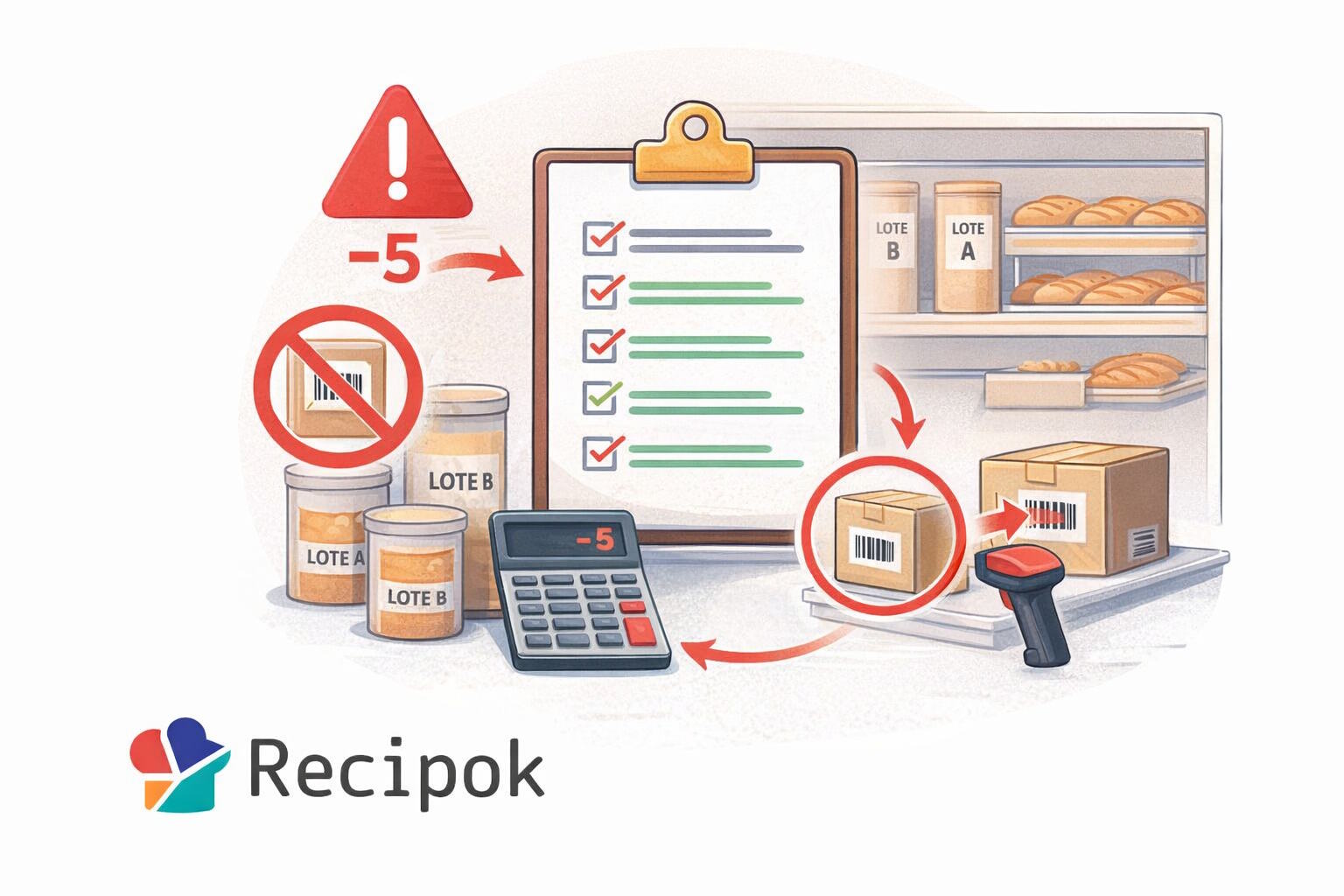
When stock does not add up, neither does traceability:
- The wrong lot is picked at production and the error carries through the whole chain.
- When there is an alert, the affected lot cannot be found quickly.
- Lots with overlapping expiry dates pile up and waste increases.
- Discrepancies cannot be traced because nobody knows what came in or what went out.
If you want to go over the basics, they are in traceability in pastry and bakery.
Three habits that put an end to discrepancies
1. Goods-in first, everything else afterwards
The order of movements matters: first the purchase is recorded as goods-in, then production happens, then the goods go out to the customer or to another store. If you produce or sell before entering the purchase, the system deducts from something that does not yet exist as far as it is concerned. It is the number one cause of negative stock. The practical rule: no delivery note stays in the tray at the end of the day.
2. Cycle counts
Instead of one full stocktake a year, count part of your stock each week: one product family (flours, dairy, nuts, semi-finished products) or one cold room. By the end of the month you have checked everything. Discrepancies show up early, while you can still find out why.
3. Record waste
What has expired, broken, gone wrong or been lost in the process has to be recorded, with its cause and its lot. Otherwise theoretical stock drifts away from real stock and your products' cost looks lower than it is. More in how to manage waste.
Why a spreadsheet falls short
A spreadsheet can keep stock levels, but it does not link stock to production, purchasing and sales. Every movement has to be written down by hand in several places, waste noted on paper does not come off the stock and, when there is an alert, it does not tell you which lots went into which production run or which customers they went to. Beyond a certain volume, keeping it up to date takes longer than doing it properly.
How stock is kept by lot in Recipok
In Recipok, stock is not one number per ingredient: it is a list of lots. Each lot knows what product it is, which supplier it came from, which location it is in, how much is left and when it expires. This is how each of the problems above is solved:
| Problem | What Recipok does |
|---|---|
| Goods-in not recorded | The goods-in creates the lot with its number, expiry date and price. On the Integral plan, Recipok reads the supplier's delivery note from a photo or a PDF so recording it takes seconds. |
| Usage not recorded | The production order deducts the ingredients' lots and, when it is finished, creates the lot for the finished product. |
| Wrong lot | Lots are sorted by expiry date and each one can carry its own QR code label: you find it by scanning, without typing numbers. |
| Sales not deducted | Deliveries and delivery notes to customers carry their lot. And Recipok connects with the till and the invoicing you already use in your shop. |
| Waste | Every adjustment to a lot asks for a reason (damaged, expired, returned…) and is saved in the history with who did it and when. |
| Counts | Stock reconciliation compares what Recipok calculates with what you count, cold room by cold room, and adjusts the differences in one go. |
And if a negative still appears? Recipok does not stop production because a delivery note is missing: it warns you, leaves the lot negative and shows it in the negative stock list. There you decide: record the missing goods-in (the right way, because it captures supplier, lot and price) or correct the lot giving a reason. All the details in stock by lot, stocktaking and reconciliation.
What you gain from reliable data
- Right-sized purchasing: no overstock and no expired goods.
- Real prices: the cost includes waste.
- Leaks in plain sight: breakages, mistakes and losses you could not see before.
- A quick response to an inspection or a product recall: Recipok runs a traceability mock recall in one click.
- Better planning: with stock up to date, the shopping list and production are calculated on accurate data. We explain it in production and planning in the workshop.
In short
Negative stock can be fixed: record goods-in before producing, count a little every week and write down waste. With stock kept by lots that are deducted automatically in production and in sales, discrepancies become an exception corrected in minutes, not a hole you drag around all year. See how lot traceability in Recipok works.